Clip lock plywood box
A clip-lock plywood box — the construction often called a male-and-female buckle box — carries a galvanised steel edge on every panel and joins those panels with stamped steel clip sets. Press the male clip into the female and the two panels lock vertically. There is no nail line and no tool in the assembly. That single detail is what makes the box foldable, re-openable and worth running in a loop.
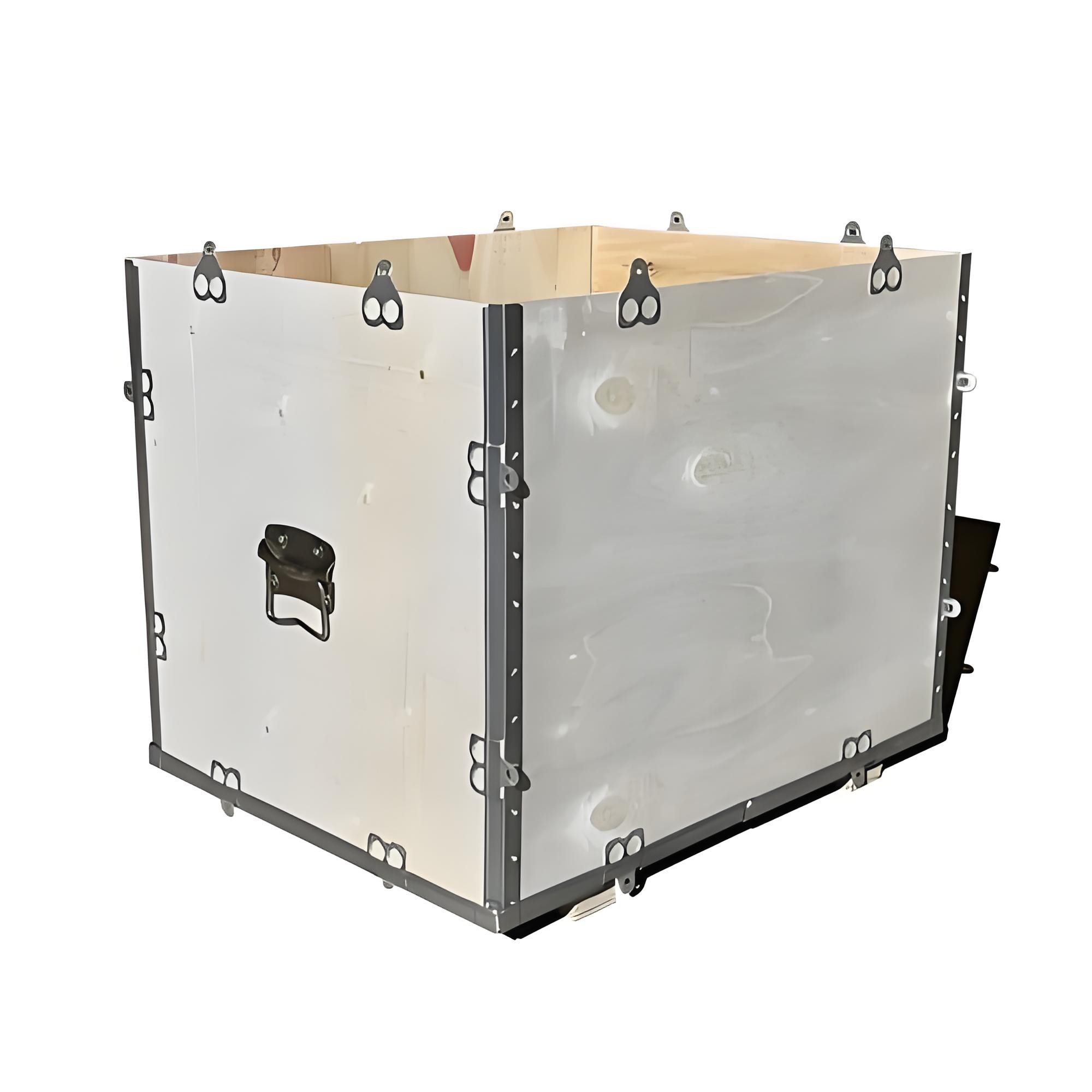
What a clip lock plywood box is
Three parts make the construction. The panel is plywood, usually poplar or pine, cut to the six faces of the box. The steel edge is cold-rolled galvanised strip, wrapped around the cut edge of each panel and fixed by rivet or crimp. The clip set is a stamped steel pair: the male half sits on one panel, the female half on the panel it meets, and the joint closes by pressing one into the other.
That division of labour matters when something fails. The panels and the steel edge take the bending and the stacking load. The clips only hold the panels in position, so a box that has been overloaded usually shows a bent edge before it shows a damaged clip.
The construction is not new, and it is not a variant of a nailed crate. A nailed crate is a one-way object: the fixing that assembles it also destroys the panel edge when the box is opened. A clip-lock box is assembled and taken apart as a normal operation, which is what puts it in the returnable category rather than the disposable one.
How the male and female clip locks a joint
The two halves are positioned on the edge of the panel, not on its face. When the male clip is pressed into the female, the joint resists separation in the direction that matters — perpendicular to the panel plane — and it holds the two panels at a fixed angle without any fastener passing through the panel.
Because nothing is driven through the panel, the joint can be opened and closed repeatedly. This is the property that makes the box usable for mid-route inspection or partial unloading: the panel comes off, the goods are checked, the panel goes back on, and the box is the same box with the same joint pattern.
The catch is alignment. The clips have to land where the opposite half already is, so the position is punched and riveted rather than marked and drilled on site. A clip set that is a few millimetres out will close on one side only, and a joint loaded on one side opens under handling.
What sets the strength of the box
Four variables decide how much a clip lock plywood box will carry: panel thickness, steel strip width, clip strength, and the number of connection points between the base and the sides. Industry descriptions of this construction commonly put the panel between 8 mm and 15 mm, with the choice driven by the load the box has to carry rather than by the box size.
The other three are set by the drawing. A wider strip raises the stiffness of the panel rim; a heavier clip raises the load a joint can take; more connection points along the base spread the load that arrives when the box is set down or lifted. Reducing any of them to save cost is how a box ends up with a rating it cannot hold on a real route.
Two things are worth stating plainly. The box is not waterproof, and no steel edge makes it waterproof — if the route is wet, the answer is a better panel or a moisture barrier inside, not a wider strip. And the panel itself has to be dry before assembly, because moisture trapped between panel and steel edge has nowhere to go once the box is closed.
Clip-lock box against the other two constructions
Against the nailless buckle box, the difference is the fastening. A buckle box joins the panel edges with steel buckles driven by a machine; a clip-lock box joins them with a clip set installed as hardware. Both are re-openable and both avoid nails. The buckle version is the one to choose when the box design is fixed and the joints are made on a line; the clip version is the one to choose when the box has to be assembled and disassembled by hand at the point of use.
Against the foldable box, the difference is what folds. A foldable box keeps hinged panels attached and collapses as one piece. A clip-lock box separates into flat panels, which travels further for the same volume but asks for more handling at each end.
On phytosanitary status all three sit in the same place: panels made from processed wood are outside the treatment requirement, and any sawn timber in the base — a skid or a runner — is solid wood and is treated separately. The final call belongs to the destination authority.
How it is constructed
- Every panel carries a galvanised steel strip rolled around its cut edge, so the panel rim is a steel section rather than exposed plywood end grain.
- Male and female clip sets are riveted at pre-punched positions on the panel edges, which is what lets the six faces locate against each other without measuring on site.
- Panels are cut as flat faces and shipped flat; the box exists only once the clips are pressed closed, which is what makes the flat return leg possible.
- A base with skids or a pallet structure takes the forklift load, sized to the fork length and width the box will actually meet.
Materials
Why this construction is used
- Assembles and comes apart without tools, so the joint survives repeated opening instead of being destroyed by it.
- Travels flat and is built on site, which cuts the volume paid for on the return leg.
- The steel edge covers the panel rim, so the part of the box that meets forklifts and stacking load is steel rather than end grain.
Production stages
| — | |
| — | |
| — |
Clip-Lock Steel-Edge Box — questions
It is the same construction described from the fastener rather than the joint. The male and female buckle — the clip set — is the pair of stamped steel halves that lock two panels together. Suppliers in different markets use clip lock box, clip-lock box and male-and-female buckle box for the same object.
The panels are processed wood, which the standard treats differently from solid wood. Any sawn timber in the base or in a cleat is solid wood and is treated separately. The compliance decision sits with the destination authority, so confirm it against your shipment before it leaves.
Yes, that is the point of the clip joint. Nothing is driven through the panel, so the joint is opened and closed as a normal operation and the box keeps the same joint pattern afterwards.
No. The steel edge protects the panel rim from impact and stacking load, not from water. On a wet route the answer is a moisture-resistant panel or a barrier inside the box, and a panel that is dry before it is closed.
Industry descriptions commonly place it between 8 mm and 15 mm, with the thickness following the load rather than the box size. Send the load, the stack height and the box drawing and the thickness can be confirmed against them.
We supply the edge preparation stages: the forming machine that rolls the strip and the press that sets it on the panel. The clip sets and the riveting tooling are part of the box design and are sourced with it. Tell us the construction you intend to build and we will confirm which stages our line covers.
Send us the box you need to build
Box sizes, panel thickness and the production stages you need are enough for us to come back with a configuration and a written quotation.