Steel edge plywood box, built around a rolled steel rim
A steel-edged plywood box is built from flat plywood panels with a galvanised steel strip rolled around the panel rim. The steel edge takes the load when the box is lifted, strapped, stacked or dragged; the plywood face carries the goods. The brochure describes this construction as rigid protection for industrial transport.
Also known as
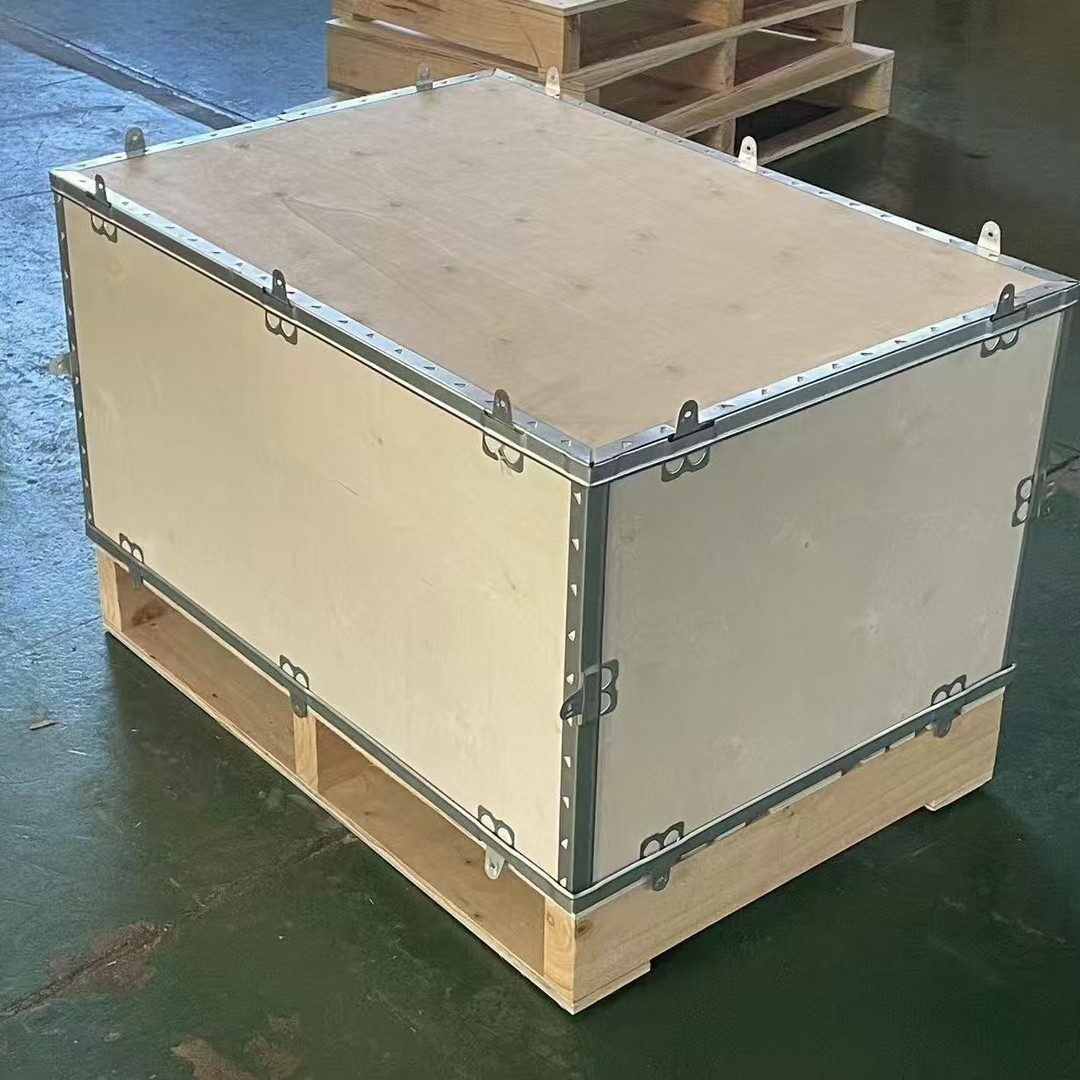
What a plywood crate is used for
A plywood crate is the enclosure you choose when the goods are heavy enough to load the box structurally and awkward enough that no standard size fits. Machinery, switchgear, pumps, fabricated assemblies and dense vehicle parts all fall into that group. The box is not a bag around the product: it is the thing that carries it, and it is designed from the product outward.
What separates a plywood crate from a timber crate is the panel. Plywood is a processed wood product — veneers bonded under heat and pressure — so the panel is dimensionally stable in both directions and does not shrink along a board width in the way sawn timber does. That stability is what lets a box be built to a drawing and stay that size.
The second difference is the edge. On a timber crate the corners are the timber members and the sheathing is an infill. On a plywood crate the panel is the structure, so the panel edge becomes the load-bearing detail, and that is the detail the steel edge is there to protect.
Why a steel edge rather than a timber cleat
A timber cleat is nailed or screwed to the panel face. It works, but every fixing is a hole in the panel, and a cleat that has been dragged on a container floor transfers its load into those fixings. When the fixing enlarges its hole the cleat loosens, and the panel edge it was protecting is exposed again.
A formed steel edge wraps the panel rim instead of sitting on the face. It is cold-rolled from galvanised strip, cut to length by an encoder on the forming machine, and then pressed onto the panel under hydraulic force. There are no fixings through the panel at the edge, and the edge itself becomes a steel section rather than an exposed panel end.
That is also why the pressing stage matters. A formed edge that is not set flat against the panel will lift at the ends, and a lifted edge catches on everything it passes: slings, pallet collars, the inside of a container.
Specifying a plywood crate for a load
Three numbers start a specification: the mass of the goods, the footprint through which that mass reaches the base, and the lifting points. Panel thickness follows from the span between bearers, not from the mass alone — a heavy item that is well supported needs a thinner panel than a lighter item standing on four small feet.
Plywood from 5 mm to 12 mm is the range specified for the DA-8000 buckle machine, and assembly length can run to 9,000 mm. Fastening is rated at 30 to 60 fastenings per minute, which becomes a capacity figure only once the fastening count for your joint pattern is known.
On the pressing side, the quoted 2.5 m build runs at 30 t nominal press force across a 2.5 m working width, and the press series is built from 40 to 100 t with platen sizes to 1,300 × 8,500 mm. If your crate is longer or wider than the working width, the box has to be split or the process changed — that is a drawing conversation, not a catalogue choice.
Plywood crate and phytosanitary rules
Because plywood is a processed wood product, a crate built wholly from it is described as fumigation-free material in many markets, and the ISPM 15 exemption covers packaging made entirely from processed wood. Any solid-wood component — a sawn skid, a timber base runner, a cleat — is a different case and is treated separately.
The compliance decision always sits with the destination authority, not with the box maker and not with the machine manufacturer. What a plywood crate does is remove one variable: when there is no sawn timber in the construction, there is nothing in the box that needs a treatment mark.
How it is constructed
- Plywood panels are cut to the box side and end dimensions.
- The galvanised steel strip is cold-rolled into the edge profile on the steel-edge forming machine.
- The formed edge is pressed flat against the panel under hydraulic force.
- Panels are fastened together with steel buckles to close the box.
Materials
| Panel material | Plywood, 5–12 mmDA-8000 specified range |
|---|---|
| Edge material | Galvanised steel strip |
| Fastening | Steel buckles |
Why this construction is used
- The steel edge protects the corner, which is the first part of a box to fail in handling.
- Plywood is a processed wood product, which many destinations treat differently from solid wood packaging.
- A damaged panel or edge can be re-made on the same line and replaced on its own.
Production stages
| Buckle fastening | DA-8000High-Spec Nailless Plywood Box Buckle Machine |
|---|---|
| Edge forming | GA-8000Steel Edge Plywood Box Machine |
| Hydraulic pressing | GA 2.5 mSteel-Edge Hydraulic Press |
Steel-Edged Plywood Box — questions
Plywood from 5 mm to 12 mm is the range specified for the DA-8000 buckle machine. The right thickness for a given box depends on the load and the panel span.
Forming cold-rolls the strip into the edge profile; pressing sets it onto the panel under stable hydraulic force, from 40 to 100 tons across the press series. A flat edge seats better on the box frame and takes stacking load more evenly.
Send us the box you need to build
Box sizes, panel thickness and the production stages you need are enough for us to come back with a configuration and a written quotation.