Reusable packing boxes, assembled without nails
A buckle box replaces the nail or staple line with steel buckles pressed into the panel joint. The brochure describes this construction as quick assembly for repeated circulation, which is what makes it suitable for closed-loop packaging. The buckle carries the shear load across the joint, and the plywood edge is not perforated the way a nail line perforates it.
Also known as
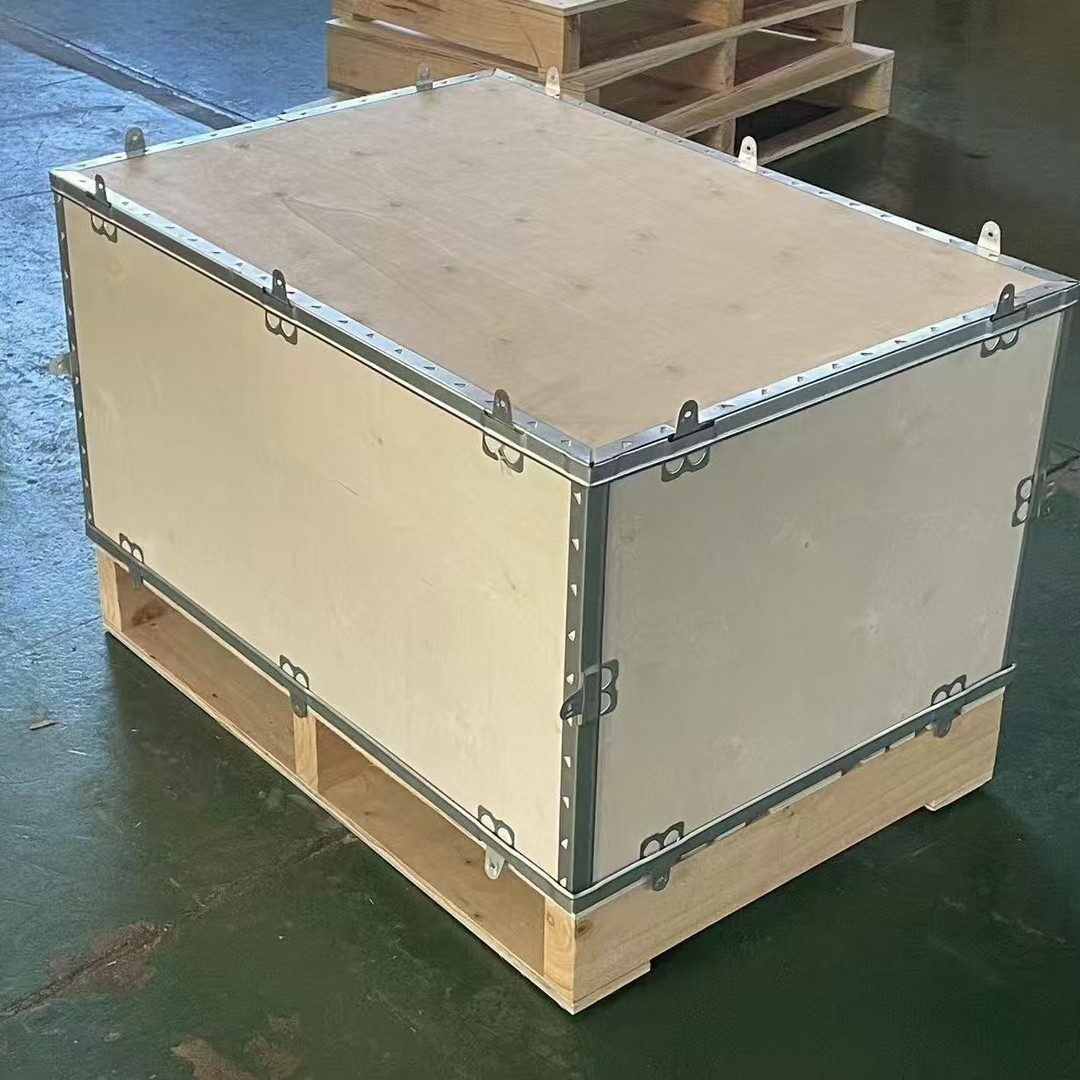
What reusable packing boxes have to survive
Reusable packing boxes fail in a different way from one-way crates. A one-way crate has to survive a single journey, so the design can be optimised for strength per unit of material. A returnable box has to survive the journey, the unpacking, the storage of the empty, and the return leg — and it has to still fit the same goods at the end of that cycle.
That changes what matters. Peak strength matters less; what matters is whether the joint is still tight on the fifth trip, whether the box is still square enough to stack, and whether a damaged panel can be replaced without rebuilding the box.
Nails are the wrong answer to that question. A nail line perforates the panel edge, and every loading cycle works the nail in its hole. The hole enlarges, the joint loses clamp, and the box starts to rack. Nothing about the panel has failed; the fastening has.
Why the joint decides the service life
A steel buckle carries the shear load across the panel joint as a folded steel component rather than as a point fixing. It is pressed into the joint at a programmed pitch on the buckle machine, so the load is shared between buckles at known intervals instead of being concentrated wherever a nail happened to land.
It is also reversible. A buckle joint can be opened and closed again with the same method, which is the property a returnable loop actually needs: a box that can be taken apart is a box whose damaged panel is one panel, not a whole unit.
The plywood range specified for the DA-8000 is 5 mm to 12 mm, at 30 to 60 fastenings per minute, with assembly length up to 9,000 mm. Those are the published limits within which the joint behaves predictably, and a box designed outside them is a different engineering problem.
Reusable packing boxes and the return leg
The cost of a returnable loop is dominated by what happens to the empties. A rigid box that comes back sealed pays for its own volume twice — once full, once empty. That is why collapsible and knock-down constructions exist, and why the choice between rigid and foldable is a freight decision before it is a production decision.
What the production stages contribute is repetition. A foldable construction and a rigid one are built from the same panels and the same edge treatment; the difference is the corner hardware and the drawings. A line that can hold a drawing can produce both.
What no line can promise is a trip count. How many journeys a box survives depends on handling, transfers and load, and it is measured in service rather than stated in a brochure. The construction is designed so that the panels which fail first can be replaced on their own.
How it is constructed
- Panels are cut to the box dimensions.
- Panels are positioned at the box corner or at the panel joint.
- Steel buckles are pressed into the joint at programmed positions on the buckle machine.
- The buckle folds the two panels into a fixed joint and the box is closed.
Materials
| Panel material | Plywood, 5–12 mmDA-8000 specified range |
|---|---|
| Fastening | Steel buckles |
| Fastening speed | 30–60 per minute |
| Max. assembly length | 9,000 mm |
| Applicable steel-strip width | 50 mm |
Why this construction is used
- No nail line along the panel edge, so the plywood edge is not split by fastening.
- Fastener positions are programmed, so joints repeat from box to box.
- Panels can be de-jointed for inspection or repair instead of being prised apart.
Production stages
| Buckle fastening | DA-8000High-Spec Nailless Plywood Box Buckle Machine |
|---|---|
| Edge forming | GA-8000Steel Edge Plywood Box Machine |
| Hydraulic pressing | GA 2.5 mSteel-Edge Hydraulic Press |
Buckle Box — questions
A buckle wraps the joint rather than piercing the panel edge, so the load is spread across the buckle and the panel face instead of a line of nail holes. The buckle machine uses a 120 kg hydraulic die assembly to press the fastener in one action.
Yes — the joint can be opened without splitting panels, and a damaged panel can be re-made on the same line. Ask us which single machine covers the repair step for your box design.
Send us the box you need to build
Box sizes, panel thickness and the production stages you need are enough for us to come back with a configuration and a written quotation.